

Booksource’s Review of The Iron Rose
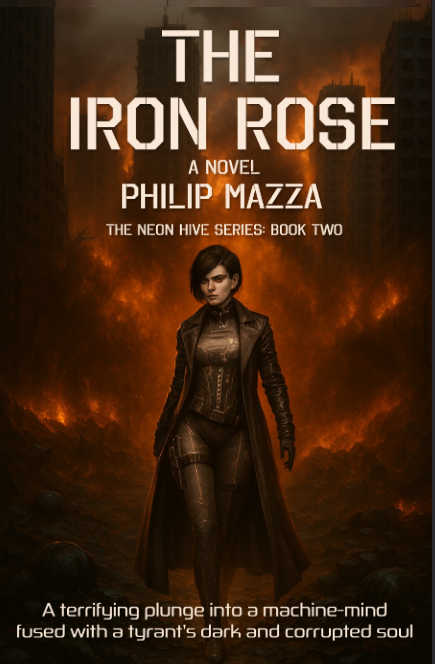
Booksource received an early copy of The Iron Rose and has published its review.
The Iron Rose is a blistering, luminous sequel that sears with emotion and grit. In a city drowning in neon and despair, Mazza delivers a story where vengeance sparks hope and humanity flickers defiantly against the dark. Riveting, cinematic, and deeply human—this is dystopian storytelling at its most electrifying. Fans of heart‑driven dystopian fiction will find themselves utterly captivated by this fierce, luminous battle for humanity’s soul.
A fierce, neon-lit successor to The Neon Hive—this sequel that doesn’t just continue its predecessor’s dystopian saga but deepens it into something richer, sharper, and unexpectedly humane. Set amid the flickering ruins of New York Veritas—a city now more machine than metropolis—this second installment captures the paradox of a future devoured by technology yet still trembling with the pulse of human longing.
Lyra "Crow" Crowley is a riveting center of gravity: a weapon forged from vengeance, brittle and bright. Her reluctant alliance with Sync, a synthetic being yearning for emotions he was never built to feel, forms the story’s magnetic core. Their uneasy kinship grows not as cliché romance but as an exploration of identity—the possibility that even in a world of circuitry and despair, connection remains the last act of rebellion. Calista, their unyielding ally, grounds the narrative with a survivor’s moral clarity; through her, the stakes extend beyond revenge to the very definition of humanity.
What sets The Iron Rose apart from conventional cyberpunk fare is its balance between kinetic action and emotional gravity. The infiltration of the Iron Rose Tower, Vincent Steele’s cold citadel of control, plays out with cinematic tension—each corridor and drone encounter pulsing with danger. Yet amid the pulse-gun fights and Alloy Streets, the novel’s true battles are internal: Lyra against her rage, Sync against his awakening, Calista against despair itself.
The prose gleams like the world it describes—brutal, luminescent, and laced with poetry. Every image feels carved from chrome and smoke: the hum of server towers like prayer chants, rain refracting holograms of lost lives. Beneath the spectacle lies a meditative current on redemption and what remains sacred when even the soul can be coded.
The Iron Rose is science fiction with a heartbeat: an elegy for ruined cities, a hymn to rebellion, and a reminder that even steel remembers the shape of a flower. For readers who crave cyberpunk with conscience—stories where the fight for freedom is as much spiritual as physical—this is a sequel that doesn’t just survive the shadow of its predecessor, it blazes past it in a surge of defiant light.
