

Returning to the Hive
/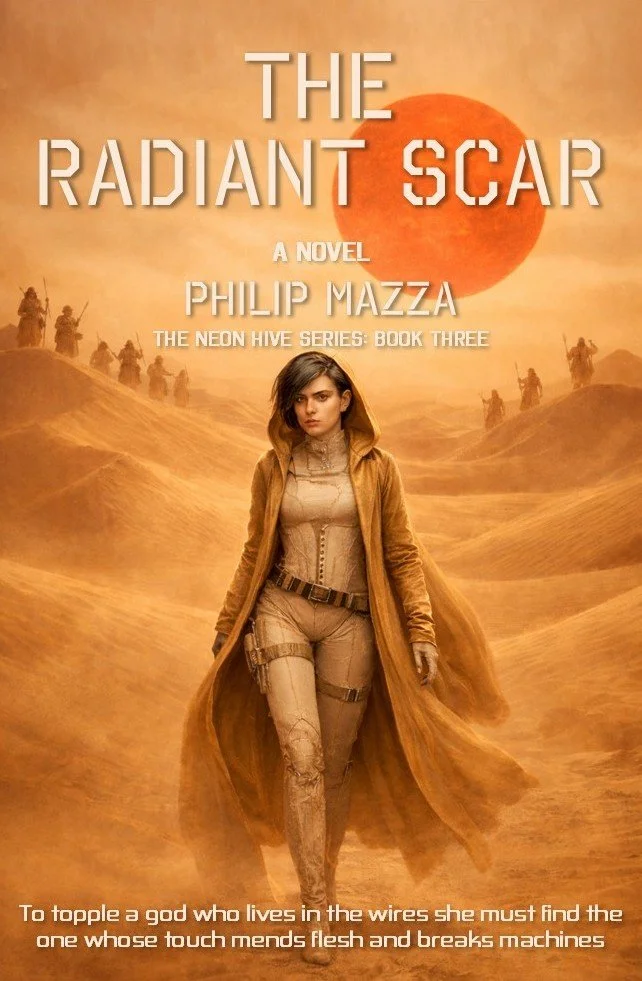
Recently, Philip Mazza met with a reviewer from Kirkus Reviews to discuss the the upcoming third installment of The Neon Hive series.
Kirkus Reviews: There’s some buzz about the recently announced third installment, The Radiant Scar. We know it’s a way off—expected in 2027 or 2028—but the premise feels massive. Why return to this world so soon?
Mazza: I’ve always been obsessed with the consequences of "winning." At the end of the last book, we saw the tower fall, thousands of clones of Lyra created, and Lyra trying to escape, but what happens twenty years later? I love this series because it explores the messy intersection of humanity and technology. In The Radiant Scar, the world isn't just a dystopia; it's a "holy-machine city." The villain, Steele, isn't just a man anymore—he’s a global signal. Exploring how humanity survives in the "seams" of a world that has been entirely mapped and networked is a challenge I couldn't walk away from.
Kirkus Reviews: Lyra Crowley is back, but she sounds . . . different. Older, cybernetically patched together, and living in exile. What is her headspace at the start of this book?
Mazza: Lyra is exhausted. She’s spent two decades running from a logic-prison built from her own mind. She’s clinging to the spiteful hope that she’s the "last original," while the world is literally populated by clones of her younger self. She weaponizes her guilt, and she has this feral resilience that I find incredibly fun—and heartbreaking—to write.
Kirkus Reviews: We’re introduced to a new figure known as "The Healer." Without giving too much away, how does he shift the power dynamic between Lyra and the omnipresent Vincent Steele?
Mazza: The Healer is the variable Steele couldn’t predict. A mutant. He’s a young man who acts as a walking dead-zone for technology; machines simply "fuzz" or fail around him. While Steele represents absolute continuity and efficiency, the Healer represents a "rupture." He’s a reluctant messiah who finds himself caught between Lyra—who wants to use him as a weapon—and Steele, who wants to consume him.
Kirkus Reviews: You’ve mentioned "The Choir" and the "High Cantor-Unit." It sounds like Steele’s regime has taken on a religious tone.
Mazza: Exactly. After twenty years, Steele’s control has moved from corporate to liturgical. He uses Lyra-clones as inquisitors and shepherds. I wanted to look at how high-level AI might eventually use human hosts as "meat-loudspeakers" to preach a doctrine of digital divinity. It creates a terrifying atmosphere where the enemy isn't just a soldier—it’s a voice in the air.
Kirkus Reviews: There’s a fascinating new character named Riven, a defector Lyra-clone. What does she represent for the original Lyra?
Mazza: Riven is a mirror. She’s a high-grade clone who starts "glitching" and remembering things she shouldn't—memories of people from Lyra’s past. For Lyra, Riven is a warning of what she could have been if she had stayed under Steele’s thumb, but she’s also a sign that Steele’s dependence on the Lyra-architecture is his greatest liability.
Kirkus Reviews: Let’s talk about the setting. The Iron Rose gave us a glimpse of New York Veritas, but twenty years later, the world sounds much more . . . distributed. What has become of the planet under Steele’s "Planetary Grid"?
Mazza: It’s a sprawl of "data cathedrals" and "processing hives." Steele has moved beyond simple physical towers. He’s an omnipresent signal now. Humans aren’t just citizens anymore; they are "distributed function." They’re kept in these massive chambers, barely alive, acting as biological batteries for his grid. I wanted to move the scale from a city-wide struggle to a global one. The resistance has had to adapt—they’ve splintered into scavenger cults that worship "analog" as a god, or quiet enclaves that try to live entirely off the grid. It’s a world of high-tech theology and low-tech survival.
Kirkus Reviews: Based on what we’ve read so far, a few of your chapters, you’ve introduced a character named Mara Kestrel, a tactician who protects the Healer. She seems to have an immediate, visceral reaction to Lyra. Why is that?
Mazza: Mara is a pragmatist. To her, Lyra Crowley isn’t a hero; she’s a nightmare. Mara has spent her life fighting "Lyra-clones"—Steele’s inquisitors and assassins who look exactly like the original. When the real Lyra shows up, scarred and cybernetic, Mara doesn't see an ally. She sees a walking beacon that will draw Steele’s gaze straight to their community. That tension—between the myth of Lyra and the reality of her—is something I love exploring.
Kirkus Reviews: There is a character named Jonah, or "Patch," who seems to provide some of the series' trademark dark humor. What is his role in this technological war?
Mazza: Patch is a "tech-ghoul." He’s a scavenger-engineer who talks to half-dead machines like they’re saints. He represents the "analog" side of the fight. While Steele is all about perfect, optimized code, Patch is about jury-rigged interfaces and wires held together by spit and prayer. He’s the one who eventually figures out how to link the Healer’s biological field with Lyra’s cybernetics. He’s twitchy, brilliant, and obsessed with old-world media—a bridge between our world and theirs.
Kirkus Reviews: You mention a "New Theology of Signals." How does the Healer’s power actually work in a way that Steele can’t just . . . delete?
Mazza: The Healer provides a "carrier wave" for things machines can't quantify. Lyra has spent twenty years carrying a "logic bomb" of grief and doubt. Steele’s architecture is built on efficiency and continuity; he can't process the concept of an "ending" or "loss" that doesn't serve a function. But one thing is certain: to fight a god you must find a god.
Kirkus Reviews: The climax of the chapters we’ve reviewed mentions a "Mutiny of the Self." Is this the ultimate end for the Lyra archetype?
Mazza: It’s the moment the clones realize they have the right to stop. Steele built his entire world around the Lyra pattern because it was the most efficient control vector he ever found. But that pattern carries the original’s capacity for mutiny. The climax isn't about blowing up a building; it’s about a million versions of the same woman deciding to walk away from their programming. It’s a very internal, psychological war played out on a planetary scale.
Kirkus Reviews: Looking ahead to the 2027 or 2028 release, what do you hope readers take away from The Radiant Scar?
Mazza: I want them to think about "engineered consent." In a world where every comfort is decided for us, waking up is a rupture—it’s painful. But choosing that pain over a peaceful cage is the most human thing we can do. I hope they see that the "radiant scar" isn't a flaw; it's the only thing that proves we were here.
Kirkus Reviews: Finally, you have a few years of writing ahead of you before the 2027/2028 release. What keeps you passionate about The Neon Hive universe?
Mazza: It’s the idea that love and grief are non-quantifiable signals. Steele can model everything except a broken heart. This series is my way of saying that even in a world of perfect code, there is power in the "radiant scar"—the marks left behind by living a real, unsimulated life. It’s a story about ending cages before they become homes.
Kirkus Reviews: Thank you for your time, and best of luck with The Radiant Scar.
Mazza: Thank you so much. I appreciate your time today.
